Growth of Early Christianity
How did a persecuted Jewish sect in Roman Judea become the dominant religion of the Western world within three centuries?
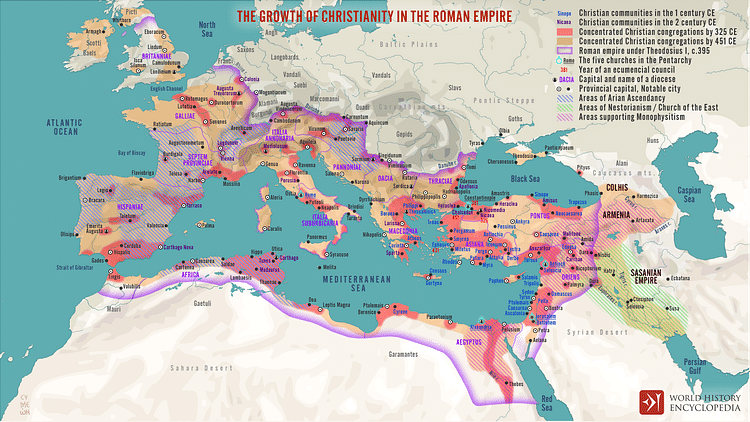
Simeon Netchev, World History Encyclopedia (CC BY-NC-ND). Shows Christianity spreading from Judea through Paul’s urban network across the Roman Empire, 1st–5th centuries CE.
The church historian, Philip Schaff notes:
“It is a remarkable fact that after the days of the Apostles no names of great missionaries are mentioned till the opening of the middle ages…There were no missionary societies, no missionary institutions…and yet in less than 300 years from the death of St. John the whole population of the Roman empire which then represented the civilized world was nominally Christianized…every congregation was a missionary society, and every Christian believer a missionary, inflamed by the love of Christ to convert his fellow-men…workers in wool and leather, rustic and ignorant persons, were the most zealous propagators of Christianity, and brought it first to women and children.” –schaffHistoryChristianChurch2019
Sovereign Design
It is clear that it was God’s design from the beginning for his image to be reflected throughout the whole earth. We see this in Genesis 1:27 as well as throughout Scripture at key covenant and covenant renewal points in the story. The promises of God hourglass illustrates God’s design for this to be fulfilled in and through Christ.

Beale’s The temple and the church’s mission does a thorough job of tracing this thread. So also does Dempster’s Dominion and dynasty.
The Social World of Paul’s Churches
Three foundational works reconstruct the social environment in which early Christianity took root:
The First Urban Christians analyzes Paul’s letters to map the social texture of the earliest congregations: their class composition, internal tensions, rituals, and governance. From Paul to Valentinus integrates archaeology, epigraphy, and literary evidence to trace Christianity in Rome across its first two centuries, from scattered house churches to a more organized community. House Church and Mission demonstrates how the household structure shaped leadership, ethics, and ecclesiology for three hundred years before purpose-built church buildings existed. A Woman’s Place recovers the roles women played as hosts, patrons, and leaders in these household assemblies, while Domestic Space and Families examines how family structures within the oikos shaped early Christian community life.
Missionary Methods: Paul’s Pattern
Missionary Methods: St. Paul’s or Ours? poses the provocation directly: Paul established self-sustaining churches in four Roman provinces within a decade, appointed local leaders, and moved on. Roland Allen contrasts this with modern missionary dependence on institutional infrastructure. The Spontaneous Expansion of the Church extends the argument: organic, Spirit-driven expansion happens when missionaries plant churches rather than establish missions, and when local believers carry the faith forward without institutional gatekeeping.
Patient Growth, Not Programmatic Mission
The Patient Ferment of the Early Church reframes the whole question. Alan Kreider documents that the early church wrote three treatises on patience but zero on evangelism. No missionary societies existed. No “Great Commission” sermons survive. Growth happened through habitus: embodied, patient, distinctive behavior that attracted outsiders by its visible difference from Greco-Roman norms. Rodney Stark calculated 40% growth per decade across the first three centuries, though Ramsay MacMullen and others dispute the numbers. The growth was real; its mechanism was social ferment, not organized outreach. Uneducated Apostles explains how this worked without formal education: illiterate apostles spoke with parresia (bold authority) because leadership formed through apprenticeship and oral transmission, not institutional credentialing.
The Pauline Team
The Pauline Team catalogs the 69 named coworkers in Acts and the Epistles. This network of apostles, deacons, benefactors, and fellow soldiers constituted the relational infrastructure through which the faith moved city to city. See also Paul’s Commission. joreEquippingServantsEarly2025 traces how deacons (diakonoi) functioned as the operational backbone of this network, documenting the shift from Paul’s flat, functional leadership model to Ignatius’s later hierarchical structure.
Theological Foundations
The content of the early proclamation mattered as much as its delivery mechanism. Kerygma captures the apostolic preaching message, and Dodd’s Apostolic Preaching is the canonical source defining its structure and theological development. Didache preserves the earliest church teaching document. The BILD Encyclicals frame these as “situational New Testament theology” rather than propositional doctrine, drawing heavily on N.T. Wright’s Christian Origins and Bauckham’s Jesus and the Eyewitnesses. The Making of the New Testament traces how these early documents were preserved, transmitted, and canonized across the expanding network of churches.
Networks and Hubs
Paul functioned as a network hub in first-century social infrastructure. Linked frames Paul’s missionary strategy through the science of scale-free networks: he targeted the largest urban centers, lowered barriers to entry (no circumcision requirement), and walked nearly 10,000 miles in twelve years to seed the faith at the most connected nodes. The parallel to modern network dynamics is direct.
Networks and Netwars extends this into networked organizational theory, and the BILD Encyclicals synthesize these network insights with New Testament theology into a practical framework for church-planting movements. Ephesiology provides a concrete case study of how this played out at the city level: 40% of the NT relates directly to Ephesus, where Paul and John connected the Jesus story to local religious, intellectual, and economic structures.
Historical Background
Backgrounds of Early Christianity provides the broader Greco-Roman, Jewish, and philosophical context in which the movement emerged.
Contemporary Movement Scholarship
Modern CPM/DMM research maps early church expansion mechanisms onto contemporary practice. Acts: The Movement of God reads Acts through movement theory, connecting apostolic patterns to reproducible frameworks. Addison’s earlier works Movements That Change the World and The Rise and Fall of Movements trace the lifecycle of missional movements from the first century forward, identifying the conditions under which they accelerate and stall. The 2023-11 CPM-DMM Reading List organizes this literature by reader type.
Related Concepts
- diaspora — the scattering of Jewish people that created the synagogue network Paul leveraged
- synagogue — the local assembly where Paul began his mission in each city
- church planting — the Pauline method applied
- MOC Discipleship & Church — the broader discipleship and church life framework
- MOC The Importance of Storying — oral tradition as transmission mechanism
- Biblical Model of Church and Mission
- oral tradition
Further Reading in the Vault
- Going to Church in the First Century — what early gatherings looked like
- Paul’s Idea of Community — Paul’s ecclesiology
- Pagan Christianity — tracing modern church practices to their non-apostolic origins
- The Forgotten Ways — reactivating apostolic movement principles
- Gathering — contemporary application of first-century gathering patterns
- Mission History — BILD’s historical framework for mission
- Christian Thought Revisited — intellectual currents in early Christianity
- joreStudyChurchHer2022 — studying church from her origins
- vosGatheringsThatAre2024 — gatherings that shape the church
- starkRiseChristianityHow1997